CHILDRENS COALITION FOR NORTHEAST LOUISIANA
  • Home
  • ABOUT
    • About Us
    • Annual Report
    • Board of Directors
    • Career Opportunities
  • School Readiness Tax Credits
  • PROGRAMS
    • Ready Start/Pre-K >
      • East Carroll
      • Lincoln
      • Morehouse
      • OPENetwork
      • Richland
      • Franklin
      • Education Stations
    • Early Childhood >
      • Ancillary Teaching Program
      • BRIGHT BY TEXT
      • Child Care Connections
      • Community Networks
      • Early Head Start
      • Pre-K Expansion
    • Early Childhood Guide
    • Parenting
    • Healthy Living >
      • Al's Pals
      • Family Garden
      • Infant Mental Health
      • U-ACT
    • Youth Development >
      • 4th JDC Youth Service Planning Board
  • EVENTS
    • Dragon Boat Festival
    • Super Saturday
    • All Events
  • SUPPORT
    • Donate
    • Become a Member
    • Grow With Us
    • Volunteer
    • Health + Social Services Directory
    • Health + Social Services Directory | Union Parish
  • Contact

CATEGORIES

All
Adolescent Reproductive Health
Adverse Childhood Experiences (ACE)
Al's Pals
Ancillary Teaching Certificate
Bully Proof
Child Abuse Prevention
Child Care Connections
Child Car Seat Safety
Community Network
COVID19
Dia De La Familia
Dragon Boat Festival
Early Childhood
Early Head Start
Family Garden
Family Resource Center
Fundraiser
Grant
Greauxing Gardens
Healthy Living
Infant Mental Health
Jus4Me
Kids 1st Morehouse
Love 146
MORE4U
Nurturing Fatherhood
Ouachita Youth Leadership Summit
Parenting
Pinwheels For Prevention
Pre K Expansion
Pre-K Expansion
Prescription Take Back
Prescription Take-Back
Ready Start Network
Ready Start Richland
School Readiness Tax Credits
Signs Of Suicide
STEM
Super Saturday
Talk Read Play Every Day In Franklin Parish
TBRI
Time To Talk
U ACT
U-ACT
Volunteer
What Works Conference
Youth Development

ARCHIVES

July 2021
June 2021
April 2021
March 2021
February 2021
January 2021
December 2020
November 2020
October 2020
September 2020
August 2020
July 2020
June 2020
May 2020
April 2020
March 2020
February 2020
January 2020
December 2019
November 2019
October 2019
September 2019
August 2019
July 2019
June 2019
May 2019
April 2019
March 2019
February 2019
January 2019
December 2018
November 2018
October 2018
September 2018
August 2018
July 2018
June 2018
May 2018
April 2018
March 2018
February 2018
January 2018
November 2017
October 2017
March 2017
February 2017
November 2016
October 2016
September 2016
August 2016
May 2016
April 2016
January 2016
December 2015
November 2015
October 2015
September 2015
June 2015
April 2015
February 2015
January 2015
August 2014
July 2014
March 2013

LOUISIANA TO AWARD $11 MILLION IN FEDERAL FUNDING TO SUPPORT CHILD CARE PROVIDERS DURING PUBLIC HEALTH CRISIS

10/15/2020

0 Comments

 
The Louisiana Department of Education today announced it will award $11 million in federal funding to child care providers. The Louisiana Child Care Assistance Provider (LaCAP) relief grant is designed to help child care providers offset the financial impacts of the COVID-19 pandemic. This fourth and final round of LaCAP grants will support Child Care Assistance Program (CCAP) providers for costs incurred from the pandemic, including balances from the inability of some CCAP parents to pay out-of-pocket costs.

The funding stems from the federal Coronavirus Aid, Relief and Economic Security, or CARES, Act. It is intended to support early learning sites that safely remained open or reopened during this unprecedented time. The deadline for submitting the LaCAP Round 4 Grant application is October 22, 2020.

"This global pandemic further illuminates the need for high quality early childhood efforts across our state," said State Superintendent of Education Dr. Cade Brumley. "While greater funding is needed to close the gaps in access to high-quality child care, these much needed funds will help our centers keep their doors open for the children they are currently serving."

The impact of the pandemic on the child care sector and Louisiana's most vulnerable families is significant. A survey conducted by the Louisiana Policy Institute for Children found the majority of child care providers have reported a loss in revenue. A significant number of child care providers are facing temporary or permanent closures. As child care providers become operational again or remain open, they face additional costs related to increased cleaning and sanitation requirements detailed in the Office of Public Health Guidelines for Child Care and other activities necessary to maintain operations. While this LaCAP grant opportunity is necessary, more financial support is needed to ensure the long-term viability of Louisiana's early childhood system.

Without additional financial support for child care, this pandemic has the potential to further exacerbate the significant gaps in access to high-quality child care in Louisiana. Prior to the pandemic, less than 7 percent of economically disadvantaged children birth through age two and less than 33 percent of economically disadvantaged three-year-olds were able to access early care and education through public funding. Because of the financial impacts of the pandemic, Louisiana child care providers are still at risk of closing their doors permanently, which would be devastating to children, families and Louisiana's economy.
​
A Blue Ribbon Commission has been studying the needs in early childhood for the past two years. The Louisiana Early Childhood Care and Education Commission has demonstrated the incredible need for increased funding to serve additional children birth through age three in its report, Funding Our Future: LA B to 3. The Commission will convene for a third year beginning this fall and will make recommendations regarding funding for early care and education to the Louisiana Legislature in January of 2021.
LACAP RELIEF GRANT APPLICATION
0 Comments

STUDY: WORKING IN CHILD CARE NOT LINKED TO COVID-19 RISK EARLY IN PANDEMIC

10/14/2020

0 Comments

 
American Academy of Pediatrics News - Child care workers in the early months of the COVID-19 pandemic did not have increased odds of contracting SARS-CoV-2, according to a new study, which noted many programs were taking precautions.

Researchers from Yale University surveyed more than 57,000 U.S. child care providers in late May and early June, asking whether programs stayed open, what safety measures the program put in place and what precautions staff took in their personal lives.

Just under half of the programs stayed open or re-opened after a brief closure. A suspected or confirmed case of COVID-19 led to closures of about 9% of those, according to “COVID-19 Transmission in US Child Care Programs,” (Gilliam WS, et al. Pediatrics. Oct. 14, 2020, https://doi.org/10.1542/peds.2020-031971).

The surveys showed that of the child care programs that continued to operate, 90% or more reported staff and children washed their hands frequently and indoor surfaces were disinfected daily. More than half disinfected indoor surfaces three times a day. Most programs performed daily symptom screenings and temperature checks of children and staff and practiced social distancing. Just over half kept children in cohorts that did not mix. However, daily face mask wearing was only 12% for children ages 2 and older and 35% for staff.

There were 427 child care providers who tested positive for SARS-CoV-2; researchers compared them to staff who did not contract the virus as well as to a group of matched controls. They found no association between contracting the virus and exposure to child care.

Odds of having COVID-19 were linked to being American Indian/Alaska Native, Latinx or Black. Taking personal precautions was linked to lower likelihood of contracting the virus.
​
“None of these covariates, however, interacted with exposure to child care, suggesting a lack of association between child care exposure and COVID-19 outcome regardless of these other factors,” authors wrote.
Read More
Guidelines
0 Comments

LDOE EARLY CHILDHOOD UPDATE WEBINAR

10/13/2020

0 Comments

 
Picture
The Louisiana Department of Education will be hosting an Early Childhood Update webinar on Thursday, discussing updated information relevant to all early childhood providers. Please follow the instructions below to access the webinar:

Webinar Date/Time: Thursday, October 15 at 3 PM
Phone Number: 1-312-626-6799
Meeting ID: 919 803 6620
Webinar Link
0 Comments

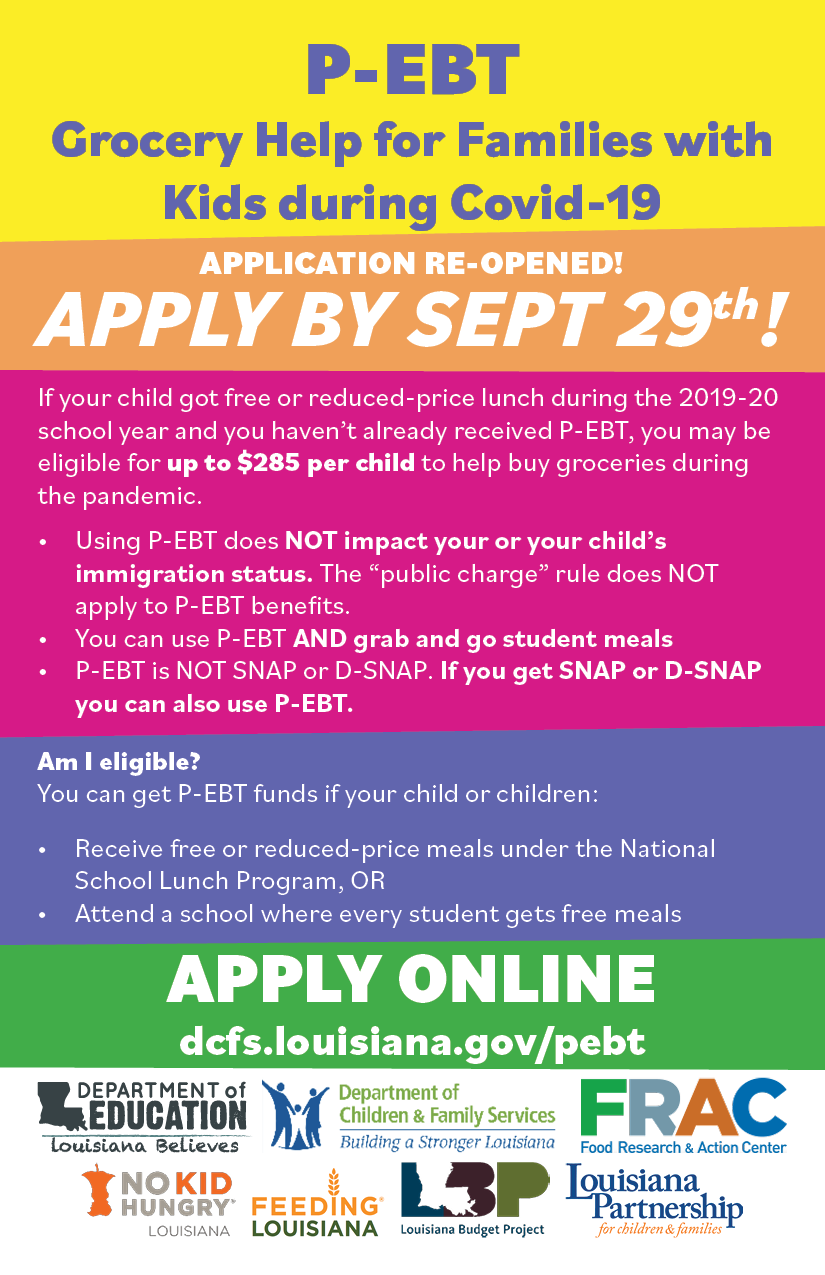
APPLY FOR P-EBT BY SEPTEMBER 29TH

9/23/2020

0 Comments

 
Picture
Apply Here
0 Comments

LOUISIANA FAMILIES HAVE ONE WEEK REMAINING TO APPLY FOR BENEFITS FROM SCHOOL MEALS MISSED WHEN CAMPUSES CLOSED IN 2019-2020

9/22/2020

0 Comments

 
Louisiana families have one more week to apply for financial benefits from free and reduced-price school meals missed when schools closed in 2019-20 due to the pandemic. Eligible families who did not apply for the Pandemic Electronic Benefit Transfer (P-EBT) program in May and June can take advantage of the second application window that will remain open until September 29 at 5 p.m. This second application window for 2019-20 benefits opened September 8. 

​Families of children who normally receive free or reduced-price meals are eligible for the program. This includes all children who attend a Community Eligibility Provision school where all students receive free and reduced-price meals regardless of income. This second application period of the 2019-20 P-EBT is only for families of the estimated 264,111 students who did not apply to receive P-EBT benefits during the initial window in the spring. When the original application window closed June 15, the families of nearly 470,800 eligible children had signed up to receive benefits.

These one-time benefits, which total $285 per child, equate the cost of meals for the 50 days schools were closed in the spring because of the pandemic, from the onset of statewide school facility closures in March through the end of the 2019-20 academic year. Parents who applied for free meals in May, after the P-EBT program was announced, will receive $91.20 per eligible child, which covers the cost of meals for 16 school days in May.

​Families must apply if they wish to receive the benefits. The application is available in a P-EBT portal on the Louisiana Department of Education website. The deadline to apply is September 29 at 5 p.m. The online application is simple, requiring only a name, address, date of birth, school district and school. Social security numbers, while helpful, are not required. The information submitted by the family, however, must exactly match the information on file with the school system in order for the application to successfully submit.

Once families complete an application in the portal, the computer system will notify them of their successful submission. Upon verification, the Louisiana Department of Children and Family Services will then request a P-EBT debit card for the household to be loaded with a one-time benefit. Applicants can expect their cards within 30 days of their application. Benefits will be available for 365 days.

P-EBT is different from the Supplemental Nutrition Assistance Program (SNAP), which is issued on a Louisiana Purchase EBT card to approved low-income households. However, the P-EBT card can be used to purchase the same eligible food for the household as can be purchased with a SNAP card. All SNAP families with qualifying students are also eligible to receive P-EBT benefits if they apply, and P-EBT also is available to non-SNAP families if they meet the P-EBT guidelines.

P-EBT is not related to loss from Hurricane Laura. Eligibility is solely based on student participation in the free or reduced-price meal program.

Louisiana was approved by the federal government to offer the P-EBT program on May 15, and the original online application launched on May 18. At that time, 611,430 children were deemed eligible. After the program began and additional families applied for free and reduced-price meals, the number of eligible children increased to 729,507.

Various factors could have influenced the number of families who were eligible but who did not submit an application. Unlike other states offering the federal program, for example, Louisiana could not automatically provide benefits to eligible families because of the state's restrictive data privacy laws for students, so every eligible family was required to submit an application. In addition, Louisiana has a large number of Community Eligibility Provision schools at which every child, regardless of their family's income, receives free and reduced-price meals at school.

The P-EBT program was authorized by Congress in the Families First Coronavirus Response Act of 2020. In obtaining federal approval for P-EBT, Louisiana joined more than 22 other states participating in the program.

For more information, consult a list of Frequently Asked Questions or contact the LAHelpU Customer Service Center at [email protected] or 1-888-524-3578. Families can also access a flyer that has been translated into Spanish, Arabic and Vietnamese. Families who need food assistance can also call 211 to inquire about food pantries and other available resources in their communities. 

LDOE and DCFS are partnering with numerous non-profit organizations to connect these benefits with eligible families who did not apply for the program during the original application period. Those organizations are Feeding Louisiana, Food Research & Action Center,  Louisiana Association of United Ways, Louisiana Budget Project, Louisiana Partnership for Children & Families, Share Our Strength/No Kid Hungry America and Share Our Strength/No Kid Hungry Louisiana.
Community Eligibility Provision School
Application Portal
Frequently Asked Questions
p-ebt information flyer
0 Comments

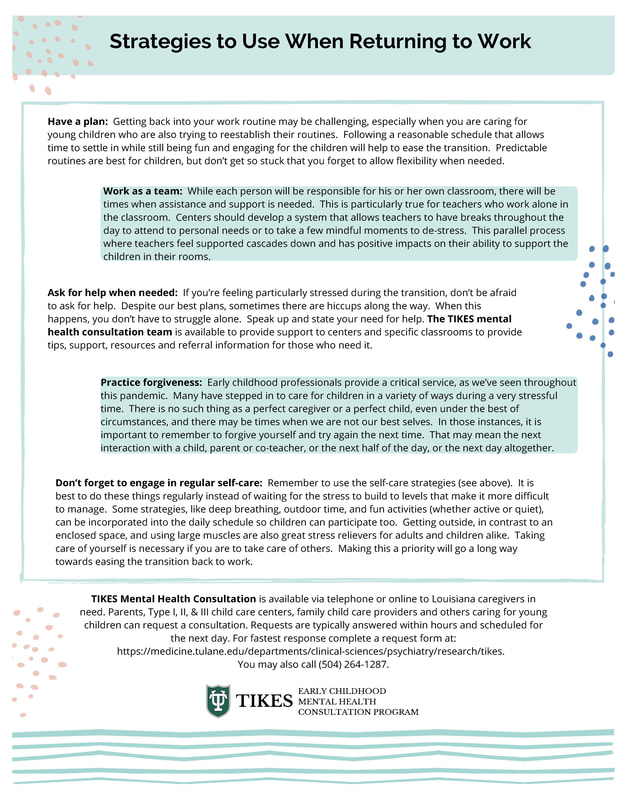
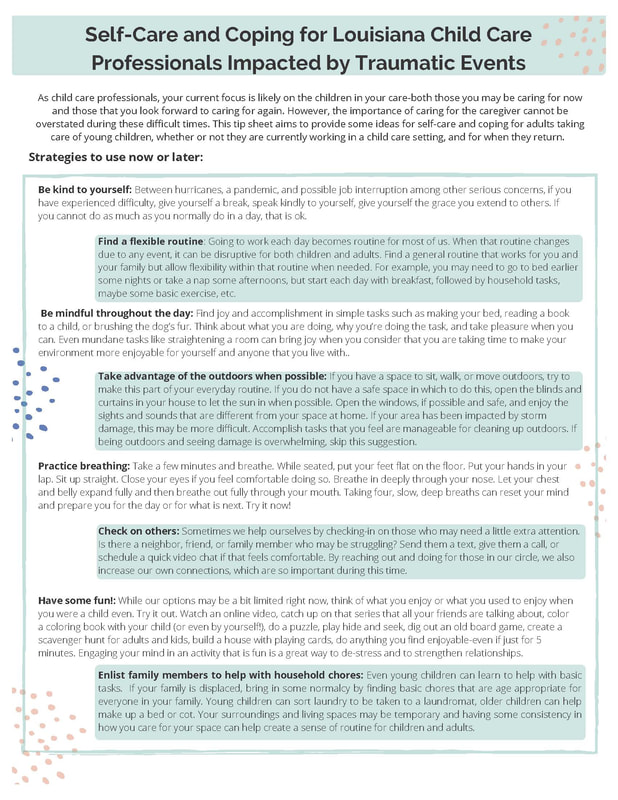
SELF CARE AND COPING FOR LOUISIANA CHILD CARE PROFESSIONALS IMPACTED BY TRAUMATIC EVENTS BY TULANE

9/17/2020

0 Comments

 
Picture
Picture
0 Comments

STATE SUPERINTENDENT DR. CADE BRUMLEY RELEASES STATEMENT ON LOUISIANA'S MOVE TO PHASE 3

9/11/2020

0 Comments

 
Governor John Bel Edwards announced that Louisiana will move into Phase 3 of the state's reopening plan. State Superintendent of Education Dr. Cade Brumley released the following statement in support of the Governor's decision.

"We as an educational community are ready to move to Phase 3. We've been successful in Phase 2 in terms of mitigating the spread of the virus, and I think we will do well in Phase 3. It's more important than ever that our schools continue to implement the safety procedures they have in place, as more students will soon return to campus."

"Our system and school leaders are being thoughtful in how they transition to Phase 3, and what that looks like will vary across the state. I know our educators look forward to welcoming students back, but they also know this transition has to be done in a way that is mindful and maintains the progress Louisiana has made in pushing back this virus. I encourage system and school leaders to collaborate with their school families to ensure a successful transition."

Dr. Brumley led a conference call for system and school leaders Thursday afternoon on what the shift means for schools and to answer questions. He was joined on the call by medical experts from the Louisiana Department of Health and Children's Hospital New Orleans. 

The Louisiana Department of Education released school reopening guidance in June that included guidelines based on various phases of reopening. The minimum health and safety standards passed by the Board of Elementary and Secondary Education (BESE) also included variations based on reopening phases. LDOE asked systems to develop reopening plans over the summer that included variations based on phases.  Phase 3 requirements for school systems differ from Phase 2 in group size, transportation, as well as band, vocal and music limitations. 

Maximum group sizes shift from 25 individuals in Phase 2 to 50 individuals in Phase 3. This is the maximum group size that may convene at any given time indoors in a single room, irrespective of room size, or outdoors. Individuals must continue to follow guidelines around face coverings and social distancing. 

School buses can now allow 75 percent of the manufacturer's capacity, compared to 50 percent in Phase 2. This capacity includes students and adults. Passengers must still be spaced throughout the bus to the greatest extent possible.
The shift to Phase 3 means band, vocal and music activities can resume indoors or outdoors. Appropriate physical distancing measures must be taken.

​Based on the state's minimum health and safety standards, if the local governing authority of a parish or other municipality has established a more restrictive phase of reopening, the school system located within that parish or municipality must follow the more restrictive requirements.
Scool Reopening Guidelines
Health + Safety Standards
0 Comments

GOVERNOR EDWARDS OUTLINES COVID-19 RESTRICTIONS AS LOUISIANA MOVES CAUTIOUSLY INTO PHASE 3 UNTIL OCTOBER 9TH

9/11/2020

0 Comments

 
​Gov. John Bel Edwards has released details of his proclamation moving Louisiana’s response to COVID-19 to Phase 3. Some businesses will be able to increase their occupancy, and bars may reopen subject to certain restrictions, only in parishes that do not have high incidence of illness and only if local governments choose to opt in.

“We have seen some improvement in decreased COVID-like illness, new COVID cases and hospitalizations in recent weeks, as our strong mitigation measures are working. That said, I want the people of Louisiana to know that moving into Phase 3 does not mean that COVID is no longer a problem for us because in fact it is. That’s why it is incumbent upon all Louisianans to follow the guidance, wear their masks and avoid going out when they are showing symptoms,” Gov. Edwards said. “We all want to see a return to normalcy, but it is going to take all of us working together to get us there. There are still some looming factors that could come to bear on the fragile gains that we have made including students returning to schools at all levels, the outcome of the Labor Day weekend and the displacement of thousands of residents by Hurricane Laura from an area that had among the highest case counts in the state. If we see a spike in cases, we may be forced to go back to a more restrictive Phase 2.”

“I also want people to be realistic, as Phase 3, with perhaps some relatively minor modifications, is likely where we stay until a vaccine is widely available,” Gov. Edwards said. “That doesn’t mean that there won’t be minor changes, but we are going to see things like the statewide mask mandate and crowd size limits in place for quite some time in our state and also across the nation.”

The new order will be in place for 28 days, expiring on October 9. In it, restaurants, churches, salons, spas, gyms and other businesses will be able to open at a maximum of 75 percent of their occupancy, with social distancing in place.
For now, bars will remain closed to on-premises consumption in parishes with high incidence of COVID as evidenced by their test positivity rate, which is a continued recommendation of the White House Coronavirus Task Force, as cases among young people and in college towns continue to grow.

Gov. Edwards’ order also outlines how bars may begin to re-open for on-premises consumption in Louisiana in Phase 3, based on the percent positivity of the parish for a two-week period. Parishes with a positivity rate of 5 percent or lower for two consecutive weeks may opt-in to open bars for on premises consumption, under the restrictions in the Governor’s order.

This two-week percent positivity will be updated every two weeks by the Louisiana Department of Health, with the next update scheduled for September 16.

When re-opened, bars will be able to open at 25 percent capacity, up to 50 people, indoors for customers seated for tableside service. They may have no more than 50 customers outdoors, socially distanced, seated for tableside service. No live music will be allowed. All drinks must be ordered at the table and delivered by bar staff to the table. Sale and service of alcohol at bars, when they reopen, must end at 10 p.m., with all patrons cleared from the building by 11 p.m. When re-opened, no one under the age of 21 is permitted in any bar.

Phase 3 also prohibits the sale or service of alcohol for on premises consumption at all establishments, including restaurants and casinos, after 10 p.m.

The statewide mask mandate will stay in place under the new order. Masks have proven to be a key mitigation measure in the fight against the spread of COVID-19. The more Louisianans who wear masks, the more Louisiana businesses can stay open.

The order continues to recommend those at higher risk of severe illness from COVID-19 stay at home unless they must leave for an essential activity, such as getting food or medical care. People with higher risk include those with compromised immune systems, those 65 and older and those with conditions like diabetes, hypertension, heart or kidney disease and obesity. Consult the CDC guidance on high risk conditions for more information.
Indoor social gatherings, like weddings or receptions, will be limited to the lesser of 250 people or 50 percent capacity of the facility. Outdoors, crowd sizes are limited to 50 percent capacity, up to 250 people, if people will be in close proximity and social distancing is not possible. Casinos will stay at 50 percent capacity and 75 percent of their gaming positions under the new order. Sporting events, like college football games, will operate at a lesser capacity of 25 percent and without alcohol sales.

Nursing home visitation will be prohibited in Phase 3, but the Louisiana Department of Health is working on a pilot program to begin to allow visitation at nursing homes with no new cases for 14 days and in parishes without high numbers of COVID-19. LDH will release details in the coming days.

Click the button below to read the updated Phase 3 order, which includes the closure of bars to on-site consumption, the statewide mask mandate and limitations on gathering size.

​Click the button below to read the extension of emergency provisions that is also extended to October 9.
Updated Phase 3 Order
Extension of Emergency Provisions
0 Comments

LOUISIANA DISASTER ASSISTANCE APPLICANTS: UNDERSTAND FEMA DETERMINATION LETTERS + HOW TO APPEAL THEM

9/9/2020

0 Comments

 
A quick fix may change the decision if you applied for FEMA help following Hurricane Laura and you disagree with your determination letter.
 
Everybody has a right to appeal. There are common reasons why FEMA may have denied your application. Read your determination letter carefully to understand FEMA’s decision and know exactly what you need to do for your appeal. Often, applicants just need to submit some extra documents for FEMA to process their application.
 
FEMA can reconsider you in some cases if you:
  • Submit insurance documents. Provide documents from your insurance company that detail your coverage or settlement is insufficient to make essential home repairs, provide a place to stay, or replace certain contents. FEMA cannot duplicate homeowner or renter insurance benefits.
  • Prove occupancy. Provide documents that prove the damaged home or rental was your primary residence by supplying a copy of utility bills, driver’s license or lease.
  • Prove ownership. Provide documents such as mortgage or insurance documents, tax receipts or a deed. If you don’t have a deed handy, contact your local or parish officials about obtaining a copy.
 
There are many other reasons you may disagree with FEMA’s decision. If you feel the amount or type of assistance is incorrect, submit a signed, written explanation outlining why you believe FEMA’s decision is incorrect and copies of any documents supporting your appeal, including proof of your disaster losses.
 
Your full name, your FEMA application number and disaster number, your pre-disaster primary residence address and your current phone number and address should be included on all submitted documents. Application and disaster numbers are printed on page 1 of your determination letter, above your name and address.
 
Instructions to submit your appeal documents:
There are four ways you can submit your letter and documents. Be sure to include the cover letter you received from FEMA when you submit them.
  1. Mail documents and your letter within 60 days of receiving your determination letter to the address below. Your letter with accompanying documents must be postmarked within 60 days of the date on your letter from FEMA regarding your eligibility. FEMA National Processing Service Center P.O. Box 10055, Hyattsville, MD 20782-7055
  2. Fax them to 800-827-8112.  
  3. Upload them online at www.disasterassistance.gov if you have a FEMA online account. To set up a FEMA online account, visit the site and click on “Check Your Application and Log In” and follow the directions.
  4. Visit a FEMA drive-thru Disaster Recovery Center. The center operates under strict COVID-19 protocols to ensure the safety of all participants. Masks or face coverings are required for entry and service. You will remain in your car. A specialist wearing a face mask will receive your documents through the window and return them to you. Find your closest center by calling the FEMA helpline at 800-621-3362 or TTY 800-462-7585, going online to www.disasterassistance.gov or downloading the FEMA app.  

​You may see Disaster Survivor Assistance team members visiting door-to-door in your area. Check for official FEMA photo identification. They will be able to answer questions and update your records if you need assistance with documents.
 
If you have questions about submitting insurance documents, proving occupancy or ownership, or anything else about your determination letter, call the FEMA helpline 800-621-3362 or TTY 800-462-7585. Those who use 711 or Video Relay Service can call 800-621-3362. 
Toll-free numbers are open daily from 7 a.m. to 10 p.m. Multilingual operators are available.
 
For the latest information on Hurricane Laura, click the button below. You can follow the FEMA Region 6 Twitter account by clicking the button below. 
FEMA LETTER
LATEST LAURA INFORMATION
www.disasterassistance.gov
FEMA Region 6 Twitter
0 Comments

LOUISIANA REOPENS 2019-2020 P-EBT APPLICATIONS FOR FAMILIES WHO DID NOT APPLY IN MAY AND JUNE

9/8/2020

0 Comments

 
Louisiana is giving families another opportunity to receive financial benefits from free and reduced-price school meals missed when schools closed in 2019-2020 due to the pandemic. Eligible families who did not apply for the Pandemic Electronic Benefit Transfer (P-EBT) program in May and June can take advantage of the second application window that opens for three weeks, beginning at 8 a.m. September 8.

Families of children who normally receive free or reduced-price meals are eligible for the program. This includes all children who attend a Community Eligibility Provision school where all children receive free and reduced-price meals regardless of income. This second application period of the 2019-2020 P-EBT is only for families of the estimated 264,111 students who did not apply to receive P-EBT benefits during the initial window in the spring. When the original application window closed June 15, the families of nearly 470,800 eligible children signed up to receive benefits.

​These one-time benefits, which total $285 per child, intend to cover 50 school days, from the onset of statewide school facility closures in March through the end of the 2019-2020 academic year. Parents who applied for free meals in May, after the P-EBT program was announced, will receive $91.20 per eligible child, which covers the cost of meals for 16 school days in May.

Local school systems will notify families they might be eligible for P-EBT. The families must then apply if they wish to receive the benefits. The application will be available in a P-EBT portal on the Louisiana Department of Education website. The portal opens September 8 at 8 a.m., and the deadline to apply is September 29 at 5 p.m. State officials expect considerable interest in the program and ask applicants to be patient in trying to access the portal.

The online application is simple, requiring only a name, address, date of birth, school district and school. Social security numbers, while helpful, are not required. The information submitted by the family, however, must exactly match the information on file with the school system in order for the application to successfully submit.

​Once families complete an application in the portal, the computer system will notify them of their successful submission. Upon verification, the Louisiana Department of Children and Family Services will then request a P-EBT debit card for the household to be loaded with a one-time benefit. Applicants can expect their cards within 30 days of their application. Benefits will be available for 365 days.

P-EBT is different from the Supplemental Nutrition Assistance Program (SNAP), which is issued on a Louisiana Purchase EBT card to approved low-income households. However, the P-EBT card can be used to purchase the same eligible food for the household as can be purchased with a SNAP card. All SNAP families with qualifying students are also eligible to receive P-EBT benefits if they apply, and P-EBT also is available to non-SNAP families if they meet the P-EBT guidelines.
P-EBT is not related to loss from Hurricane Laura. Eligibility is solely based on student participation in the free or reduced-price meal program.

Louisiana was approved by the federal government to offer the P-EBT program on May 15, and the original online application launched on May 18. At that time, 611,430 children were deemed eligible. After the program began and additional families applied for free and reduced-price meals, the number of eligible children increased to 729,507.
Various factors could have influenced the number of families who were eligible but who did not submit an application. Unlike other states offering the federal program, for example, Louisiana could not automatically provide benefits to eligible families because of the state's restrictive data privacy laws for students, so every eligible family was required to submit an application. In addition, Louisiana has a large number of Community Eligibility Provision schools at which every child, regardless of their family's income, receives free and reduced-price meals at school.

The P-EBT program was authorized by Congress in the Families First Coronavirus Response Act of 2020. In obtaining federal approval for P-EBT, Louisiana joined more than 22 other states participating in the program.
For more information, consult a list of Frequently Asked Questions or contact the LAHelpU Customer Service Center at [email protected] or 1-888-524-3578. Families who need food assistance can also call 211 to inquire about food pantries and other available resources in their communities.

LDOE and DCFS are partnering with numerous non-profit organizations to connect these benefits with eligible families who did not apply for the program during the original application period. Those organizations are Feeding Louisiana, Food Research & Action Center,  Louisiana Association of United Ways, Louisiana Budget Project, Louisiana Partnership for Children & Families, Share Our Strength/No Kid Hungry America and Share Our Strength/No Kid Hungry Louisiana.
P-EBT ONLINE APPLICATION
P-EBT FREQUENTLY ASKED QUESTIONS
Community Eligibility Provision school
0 Comments
<<Previous

    ARCHIVES

    July 2021
    June 2021
    April 2021
    March 2021
    February 2021
    January 2021
    December 2020
    November 2020
    October 2020
    September 2020
    August 2020
    July 2020
    June 2020
    May 2020
    April 2020
    March 2020
    February 2020
    January 2020
    December 2019
    November 2019
    October 2019
    September 2019
    August 2019
    July 2019
    June 2019
    May 2019
    April 2019
    March 2019
    February 2019
    January 2019
    December 2018
    November 2018
    October 2018
    September 2018
    August 2018
    July 2018
    June 2018
    May 2018
    April 2018
    March 2018
    February 2018
    January 2018
    November 2017
    October 2017
    March 2017
    February 2017
    November 2016
    October 2016
    September 2016
    August 2016
    May 2016
    April 2016
    January 2016
    December 2015
    November 2015
    October 2015
    September 2015
    June 2015
    April 2015
    February 2015
    January 2015
    August 2014
    July 2014
    March 2013
    CATEGORIES

    All
    Adolescent Reproductive Health
    Adverse Childhood Experiences (ACE)
    Al's Pals
    Ancillary Teaching Certificate
    Bully Proof
    Child Abuse Prevention
    Child Care Connections
    Child Car Seat Safety
    Community Network
    COVID19
    Dia De La Familia
    Dragon Boat Festival
    Early Childhood
    Early Head Start
    Family Garden
    Family Resource Center
    Fundraiser
    Grant
    Greauxing Gardens
    Healthy Living
    Infant Mental Health
    Jus4Me
    Kids 1st Morehouse
    Love 146
    MORE4U
    Nurturing Fatherhood
    Ouachita Youth Leadership Summit
    Parenting
    Pinwheels For Prevention
    Pre K Expansion
    Pre-K Expansion
    Prescription Take Back
    Prescription Take-Back
    Ready Start Network
    Ready Start Richland
    School Readiness Tax Credits
    Signs Of Suicide
    STEM
    Super Saturday
    Talk Read Play Every Day In Franklin Parish
    TBRI
    Time To Talk
    U ACT
    U-ACT
    Volunteer
    What Works Conference
    Youth Development

    RSS Feed

QUICK LINKS

LOOKING FOR CHILDCARE
LOOKING FOR CLASSES
VIEW ALL EVENTS
© Children's Coalition for Northeast Louisiana.
117 Hall Street, Monroe, LA 71201 | Phone: 318.323.8775
​The Children’s Coalition for Northeast Louisiana is a membership-based 501(c)3 non-profit organization dedicated to creating communities where children and families thrive (EIN: 72-1502186).
2018 Thomas H. Scott
​Spirit of Community Award Winner
Picture
  • Home
  • ABOUT
    • About Us
    • Annual Report
    • Board of Directors
    • Career Opportunities
  • School Readiness Tax Credits
  • PROGRAMS
    • Ready Start/Pre-K >
      • East Carroll
      • Lincoln
      • Morehouse
      • OPENetwork
      • Richland
      • Franklin
      • Education Stations
    • Early Childhood >
      • Ancillary Teaching Program
      • BRIGHT BY TEXT
      • Child Care Connections
      • Community Networks
      • Early Head Start
      • Pre-K Expansion
    • Early Childhood Guide
    • Parenting
    • Healthy Living >
      • Al's Pals
      • Family Garden
      • Infant Mental Health
      • U-ACT
    • Youth Development >
      • 4th JDC Youth Service Planning Board
  • EVENTS
    • Dragon Boat Festival
    • Super Saturday
    • All Events
  • SUPPORT
    • Donate
    • Become a Member
    • Grow With Us
    • Volunteer
    • Health + Social Services Directory
    • Health + Social Services Directory | Union Parish
  • Contact